Choose the Turn Order That Fits Your Tactical Game
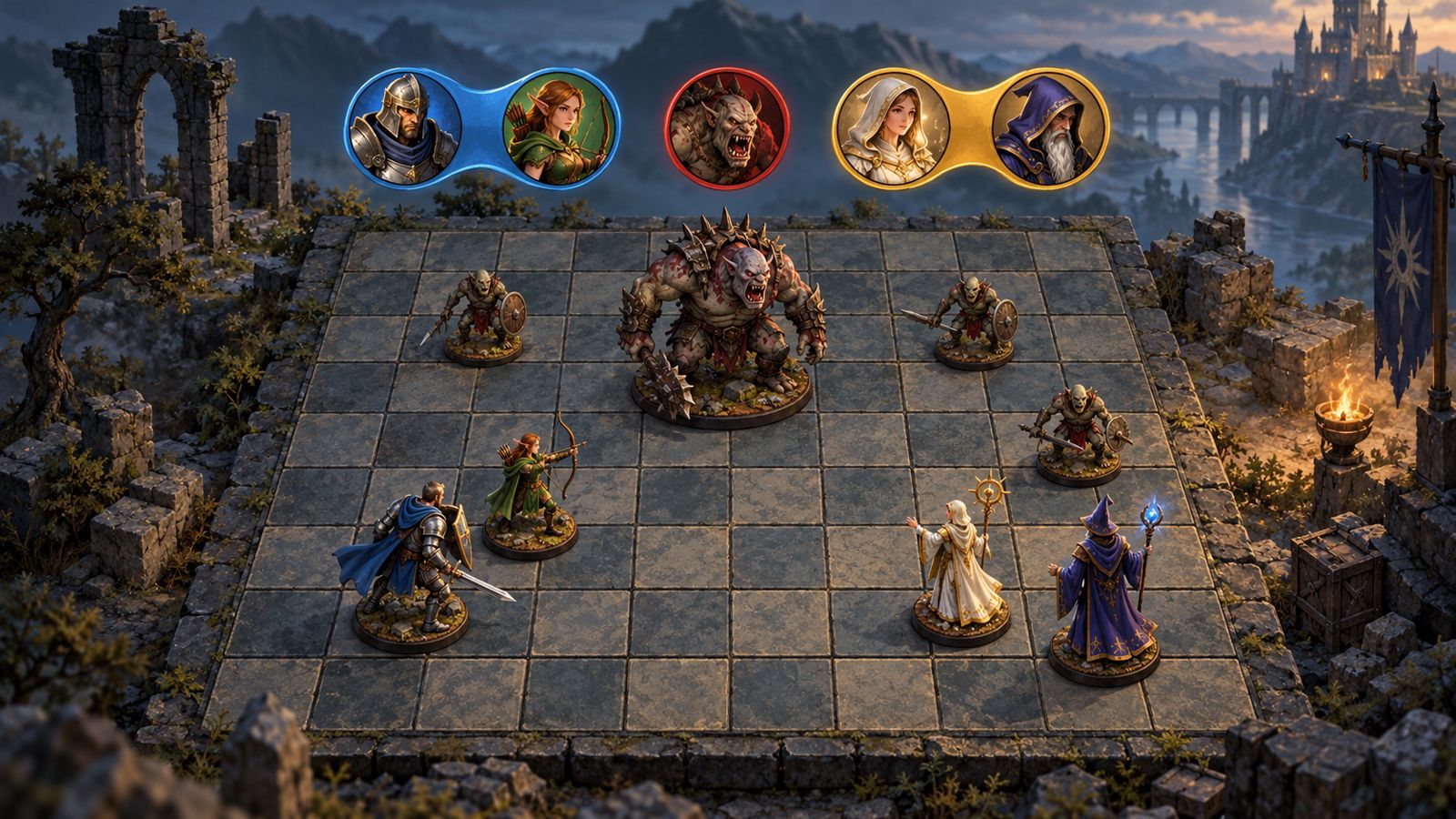
Your fighter can push a monster into the archer's line of fire. But does the archer shoot next, or does the monster get a chance to move? Turn order decides whether that setup is a reliable combination or a risk. In our Reddit discussion about a tactics game, the starting point was four heroes against a monster and its minions on a 9×9 grid, with no randomness. What mattered was how much of that squad's plan the player could complete before an enemy intervened.
Side turns: give the player room to build a combination
In a basic side-turn system, the player activates the whole squad, then the enemy activates its units. This suits combat built around coordinated actions. For a hypothetical combo, one hero strips armor, another pushes the target, and a third attacks through the opening. If the player can choose their units' order, the challenge is arranging those actions well. The enemy does not need to interrupt for sequencing to matter.
Your own actions still change the board. One hero can clear a path or apply a debuff that makes the next hero's attack worthwhile. If those changes barely affect the remaining choices, the phase can feel like a checklist. The enemy waiting is not the problem on its own. The risk is that a whole squad can remove threats before they respond. Test opening bursts and long enemy phases. A first strike that deletes several enemies may matter more than any clever combo you designed.
Individual turns: choose between flexible activation and a fixed queue
There are two different ways to mix the sides. With alternating activation, each side usually chooses an eligible unit, activates it, then hands control back. The decision includes which hero to use now and which to save. With initiative, units occupy positions in an ordered queue. That order may put several enemies or allies together; it does not guarantee strict alternation. For a deterministic design, the queue can follow visible stats and a fixed tie-break rule rather than a roll. Make the rule legible before asking players to build around it.
Individual initiative suits heroes who can make useful decisions independently. It also creates deadlines: can the healer act before the wounded ally is attacked? The cost is that an enemy may interrupt a multi-hero setup. That can create worthwhile counterplay or make the abilities feel unreliable, depending on how much the game depends on combos. Keep turn position separate from action frequency. Acting earlier once per round is not the same benefit as acting more often on a continuous timeline. The latter also changes how many actions a fast unit receives, so it needs its own balance work. For alternating activation, decide what happens when one side has more units: the remaining activations cannot simply be ignored.
Initiative blocks: preserve some freedom without granting a whole team turn
A useful hybrid keeps the initiative queue but lets adjacent allies act in any order within their block. For example, take this queue: fighter, archer, enemy, healer, mage. The fighter and archer share one block; the healer and mage share another. You can choose the order within each pair, but you cannot move a hero's turn past the enemy. We chose this approach because our heroes are fairly independent and combos are optional. They can coordinate when the queue puts them together, but a combo across two blocks has to survive the enemy's turn.
Larian's 2020 description of its Baldur's Gate 3 combat design offers a related reference: consecutive combatants of the same faction could be commanded together. You do not need to copy its random initiative rolls to explore that grouping idea. Define your own boundaries: can players switch between partly completed turns, or must each hero finish before another starts? Also decide when blocks are recalculated after deaths or initiative changes. If initiative upgrades can group the entire squad, test whether doing so is an interesting option or the obvious answer to almost every encounter. The second outcome suggests that initiative is mostly a tax paid to recover side turns.
Simultaneous planning: make prediction part of the challenge
Another option is to plan both sides' orders before resolving them together. Frozen Synapse's publisher describes this plan-and-execute structure. It changes the design problem: the player commits before seeing the complete outcome, rather than choosing each action from an updated board. Deterministic resolution can still contain uncertainty if enemy orders are hidden. Revealing those orders instead shifts the challenge toward solving a visible situation. Choose this approach if anticipating movement and coordinating timing are central to the game. It is a substantial change from ordinary unit turns: crossing paths, invalid targets, and actions interrupted during execution all need explicit rules.
Reactions are a separate choice, not a reason to pick initiative
A reaction lets a unit respond outside its normal activation. It can work with side turns, individual initiative, or blocks. You do not have to change the whole turn system just to let a defender protect an ally during the enemy phase. But that response needs a cost and a precise trigger. Does guarding consume the hero's action now, a reserved resource, or a separate allowance? When does that allowance refresh? If the reaction is free, its power still belongs in the encounter's action economy. Adding more interrupts does not automatically add better decisions.
For a game without randomness, show what will happen before the player commits. For example, a movement preview could warn: “Entering this tile triggers the archer's shot and spends its last reaction.” Highlight the triggering step, not only the destination. If several reactions qualify, show their resolution order. Specify whether a reaction happens before or after the triggering move, then handle cases where it kills a unit, moves a target, or invalidates the next reaction. The preview must follow the same rules as the actual resolution. A hidden priority rule can make a deterministic fight feel arbitrary just as effectively as a surprise dice roll.
Test the decisions before committing to the system
For our four-hero design, we'd start by testing initiative with allied blocks. Each hero has one move and one action per round; some talents are limited per room, while health loss and wounds carry between rooms. Changing turn order won't settle all of that balancing. A boss does not become threatening merely because its place in the queue changes. How often it acts, what its minions do, and what damage the squad carries into the next room are separate tuning decisions. Start with a small encounter and compare side turns, individual initiative, and the block variant before adding more abilities.
- Test a useful combination. Give the squad a setup that requires two heroes. Watch whether an enemy interruption creates a new decision or simply makes the setup not worth attempting.
- Test an urgent rescue. Put an ally in danger and ask the player to explain when help can arrive. Check whether the queue and reaction previews support that explanation.
- Test the opening burst. Can the first side remove the opponent's meaningful actions before it responds? Then change the starting order and inspect the difference.
- Test uneven sides. Add minions, remove an early unit, and check for stretches where one side takes many unanswered actions. Decide whether passing or grouped activations are needed.
- Test the strongest timing build. Deliberately stack initiative or reaction advantages. Look for a strategy that crowds out other builds, including permanent full-squad blocks.
For the first comparison, keep the map, abilities, and enemy plan as similar as the rules allow. Note what each ordering makes possible before rebalancing it away. Then tune the promising version and test again. Ask players what they expected to happen next and where their plan broke. A short round is not necessarily a good round; a longer decision may be worthwhile if the player understands what they are weighing.
Choose side turns when uninterrupted squad coordination is the main attraction. Try alternating activation when choosing who goes next should itself be a decision, or a visible initiative queue when committing around known deadlines matters more. Use blocks when you want some local freedom inside that queue. Consider simultaneous planning when prediction deserves to be the core challenge. Reactions can supplement several of these approaches, but every extra rule should earn its place. The best turn order for your game is the one that makes its most interesting decisions happen often enough to carry the combat.